Uneven driveways, sinking sidewalks, and cracked patios are usually not a “bad concrete” problem. They’re an under-the-concrete problem. This guide from Tillotson Enterprises explains what causes settlement in Nebraska and how polyurethane foam lifting restores stability quickly and cleanly.
Why concrete settles so often in Nebraska
If you live in Nebraska, you’ve probably seen it: a sidewalk panel that drops just enough to become a trip hazard, a driveway corner that sinks and holds water, or a patio that starts sloping toward the house instead of away. Concrete settlement is common here because the conditions under many slabs are constantly changing.
Nebraska soils often include clay-rich layers that respond strongly to moisture. When clay gets wet, it can soften and lose strength. When it dries, it can shrink and pull away from the slab. Add in heavy spring rains, snowmelt, irrigation, and freeze–thaw cycles, and you get repeated stress on the support soil beneath concrete.
The big idea: Concrete doesn’t “sink” because it gets old. It settles because the soil beneath it changes - erodes, compresses, washes out, dries, or shifts. Fixing the soil support is what fixes the slab.
The signs homeowners notice first
Most homeowners don’t notice settlement at the moment it starts. The first clues are usually practical annoyances: water puddles that weren’t there before, a small edge you catch with a lawn mower, or a crack that keeps widening. Common symptoms include:
- Trip hazards at sidewalk joints or steps
- Pooling water on driveways, patios, or garage approaches
- Cracks that spread from control joints or corners
- Gaps where slabs meet the foundation, garage floor, or stoop
- Settled approaches at driveways or front steps that make snow shoveling harder
These issues aren’t just cosmetic. Water pooling can speed up deterioration, worsen freeze–thaw damage, and increase slip hazards. Trip hazards can create liability risks, especially at front walks, rentals, or commercial entries. And when slabs slope toward the home, you can increase moisture near the foundation - something Nebraska basements do not need.
The real causes: soil movement, voids, and water
Concrete is heavy and strong in compression, but it needs uniform support. When the soil beneath it becomes uneven, you get stress concentrations that lead to cracking, rocking, and settlement. In Nebraska, settlement often comes from a combination of these factors:
1) Soil consolidation (compaction over time)
Even if the slab was poured correctly, the fill soil underneath may settle over months or years - especially if it wasn’t compacted well during construction. This is common near:
- Newer neighborhoods and backfilled areas
- Utility trenches (water, sewer, electrical)
- Edges of driveways and patios where fill transitions
2) Erosion and washout
Water is a powerful soil-mover. Downspouts that dump next to the driveway, negative grading, or poor drainage paths can carry fines out from under the slab and leave empty space behind. Over time, those voids get bigger, and the slab loses support.
3) Expansive clay behavior
Clay soils in Nebraska can swell when wet and shrink when dry. That movement can pump soil and water along the edges of slabs, create gaps, and reduce uniform support. This is why a slab can look “fine” in one season and noticeably worse in another.
4) Freeze–thaw cycles
When water sits under or against a slab and freezes, it expands. Repeated freezing and thawing can disturb soil structure, create micro-voids, and worsen cracking - especially where water pools on top and seeps into joints and hairline cracks.
5) Plumbing leaks or irrigation issues
A slow leak can soften soil, wash out fines, and create a void directly under a slab - often showing up as a localized “sink” or sudden drop. If you see a specific area worsening quickly, it’s worth checking for water sources (sprinklers, hose spigots, drains, or underground lines).
Why replacement alone often disappoints: If you remove a settled slab and pour a new one on the same weak, washed-out, or poorly drained soil, there’s a real chance the new concrete settles again. A long-lasting fix addresses support and drainage - not just the surface.
How polyurethane lifting works (homeowner-friendly explanation)
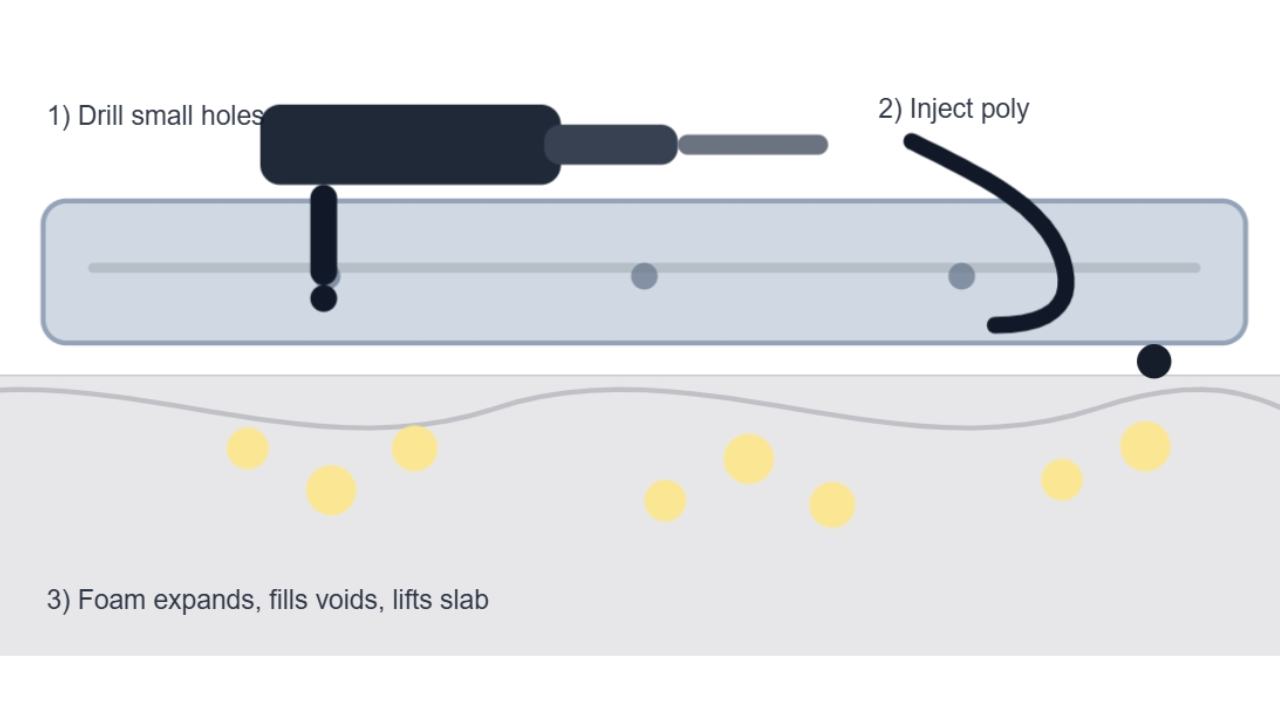
Polyurethane foam lifting - often called poly, polyjacking, or foam lifting - is a modern way to stabilize soil and lift settled concrete without tearing everything out. The concept is straightforward:
- Small holes are drilled through the slab.
- A high-density polyurethane material is injected beneath the concrete.
- The material expands, filling voids and gently raising the slab.
- Once level, holes are patched and the surface is ready for use - often the same day.
Instead of adding a lot of heavy material under the slab (as with traditional mudjacking), polyurethane foam is lightweight but strong. That means it provides support without significantly increasing the load on already sensitive soils.
What “poly” actually fixes
Poly resolves the core problem: missing or weakened support under the slab. As it expands, it can:
- Fill voids created by washout and erosion
- Stabilize soft zones by densifying the support area
- Lift settled panels to reduce trip hazards and improve drainage
- Reduce rocking and movement that causes cracking and joint separation
Real before/after examples (what homeowners care about most)
Here are real-world examples of the kinds of concrete issues Nebraska homeowners deal with - sunken driveway panels, uneven sidewalk joints, and slabs that have started holding water. In many cases, poly lifting restores a safer, flatter surface and helps water drain properly again.

Why poly is a great fit for Nebraska homes
Polyurethane lifting has become popular because it fits what homeowners want: a solution that is effective, fast, and minimally disruptive. In Nebraska specifically, poly offers several advantages:
- Fast cure time: Many areas can be walked or driven on within hours, not days.
- Precision lift: Controlled injection helps fine-tune elevation and reduce hazards.
- Lightweight support: Adds far less weight than cement-based grouts.
- Moisture resistance: The cured material is resistant to water compared with many traditional fill materials.
- Less disruption: No tear-out, no forms, no long cure windows, and minimal landscaping impact.
Poly vs. mudjacking vs. replacement (in homeowner terms)
Each method has a place, but the “best” choice depends on your slab and your goals:
- Replacement: Often highest cost and most disruptive; can be necessary when concrete is badly broken or missing sections.
- Mudjacking: Uses a cement slurry; can work, but adds significant weight and may be more vulnerable to washout in some conditions.
- Polyurethane lifting: Lightweight, quick cure, precise lift; excellent for many residential slabs that are structurally intact but settled.
Rule of thumb: If the concrete is mostly intact and the primary issue is settlement (not severe disintegration), polyurethane lifting is often the most efficient path to a safer, flatter surface.
How to keep concrete from settling again
No lifting method can “break the laws of water.” If water keeps moving soil away from under the slab, settlement can return. The best long-term results come from pairing lifting with basic water management. Nebraska homeowners should focus on:
1) Downspouts that discharge away from slabs
Short downspouts dumping next to driveways and sidewalks are a major cause of washout. Extensions, buried lines, or splash blocks can help move water away so it doesn’t travel under the slab.
2) Positive grading
Soil should slope away from the house and away from slab edges where possible. Even small negative slopes can collect water and feed voids.
3) Joint and crack sealing (when appropriate)
Sealing joints and cracks can reduce surface water infiltration. It won’t stop all moisture movement (water finds a way), but it can reduce the amount that gets beneath slabs during storms.
4) Address irrigation overspray and standing water
Sprinklers hitting concrete edges daily can soften soil and cause long-term movement. Adjust heads so lawns get water without soaking slab edges.
5) Watch for rapid changes
If a slab suddenly drops in one area, it can indicate a localized washout or leak. Early detection is your friend.
What to expect during a Tillotson poly leveling appointment
Homeowners often want to know what happens on the day of service. A typical polyurethane leveling visit starts with a quick walkthrough: we look at the slab layout, identify low points, and discuss what “level” means for your specific situation. In many cases, the goal is to reduce trip hazards and restore proper drainage, even if a perfectly factory-flat finish isn’t realistic due to existing cracks or slab geometry.
Next, small injection holes are drilled in strategic locations. We inject in stages and watch how the slab responds. Because lift is controlled, we can make small adjustments as we go. After the slab is raised and stabilized, holes are patched and the surface is cleaned up. Many homeowners are surprised by how little disruption there is compared to demolition and replacement.
Common myths about settling concrete
- Myth: “The concrete is bad.” Reality: Most settlement is caused by changing support soil, not defective concrete.
- Myth: “It will stop on its own.” Reality: Settlement often continues until voids are filled and water is managed.
- Myth: “Replacement is always best.” Reality: If the slab is intact, lifting is usually faster, cleaner, and more cost-effective.
Cost and value: why homeowners choose poly
Pricing depends on the size of the slab, how much lift is needed, and how many injection points are required. But many Nebraska homeowners choose poly because it protects value in multiple ways: it removes trip hazards, improves curb appeal, reduces water pooling, and can help keep water away from the foundation. Compared with replacement, it usually involves less downtime and fewer hidden costs (like landscaping repair, hauling, and extended cure time).
FAQ: Nebraska concrete settlement and polyurethane lifting
How long does polyurethane lifting take?
Many residential jobs are completed in a few hours. Because the material cures quickly, you can often use the area the same day. Exact timing depends on slab size, number of panels, and how much correction is needed.
Will poly lifting crack my concrete?
The goal is controlled, gradual lift. Pre-existing cracks may remain visible (because they already exist), but careful lifting helps avoid creating new damage. If concrete is already severely broken or thin, a technician may recommend replacement for those sections.
Does poly stop water from coming back under the slab?
Poly fills voids and improves support, but drainage still matters. The best long-term results come from addressing the source of water: downspouts, grading, pooling, and leaks.
Is poly lifting only for driveways?
No. It’s commonly used for sidewalks, patios, garage floors, pool decks, steps, and approach slabs - anywhere concrete has settled but is still generally intact.
How do I know if my slab is a good candidate?
If the primary issue is settlement (trip hazard, slope, pooling water) and the slab hasn’t crumbled or broken into many pieces, polyurethane lifting is often a good option. An on-site evaluation can confirm slab condition and likely causes.
Next steps for Nebraska homeowners
If you’re dealing with uneven concrete, the first step is identifying why it moved: drainage, soil consolidation, erosion, or leaks. Then you can choose the right fix - often polyurethane lifting - so you’re not repeating the same problem.
Need help? Tillotson Enterprises serves homeowners across Nebraska with concrete leveling and stabilization. We’ll explain what’s happening under your slab, what can realistically be corrected, and what changes will help keep it stable.