Nebraska's all-time temperature range runs from 118°F to -47°F. The largest hailstone ever recorded in the state, by weight, circumference, and diameter, fell in Aurora in 2003, coincidentally the same town where Tillotson has had an office for years. That kind of swing isn't a once-a-decade outlier here. It's a normal part of what a commercial roof has to survive, year after year, which makes the TPO vs. EPDM decision less academic in Nebraska than it might be somewhere with a milder, more consistent climate.
Both are single-ply membranes, both are common choices for flat and low-slope commercial roofs, and both get pitched hard by whoever happens to install one over the other. The honest answer to "which is better" is that neither one wins outright, even here. They fail differently, they perform differently depending on conditions, and the right choice depends on specifics most sales conversations skip over.
Here's what actually separates them, and what Nebraska's weather does to that comparison.
What Is TPO Roofing?
TPO (thermoplastic polyolefin) is a newer single-ply membrane, and it's become the most widely used single-ply option in commercial roofing today. It's manufactured as a thermoplastic, which matters more than it sounds like it should: thermoplastic seams can be heat-welded together, fusing adjacent sheets into essentially one continuous membrane rather than two sheets held together with adhesive. TPO is also typically white or light-colored, reflecting sunlight rather than absorbing it.
What Is EPDM Roofing?
EPDM (ethylene propylene diene monomer) is a synthetic rubber membrane that's been in commercial use since the 1960s, making it the most time-tested single-ply option on the market. Unlike TPO, EPDM is a thermoset, not a thermoplastic, which means its seams can't be heat-welded. They're glued or taped instead. EPDM is prized for its flexibility and is traditionally black, though white EPDM formulations exist for buildings that want the reflective benefit.
The Difference That Actually Matters: Seams
Materials aside, seams are where most single-ply roofs actually fail. TPO's heat-welded seams create a fused, monolithic bond between sheets. EPDM's glued or taped seams are a mechanical bond, not a chemical one, and they're the most common point of failure on an aging EPDM roof. This is the single biggest practical difference between the two systems, and it matters more over the life of the roof than almost anything else on a spec sheet.
That doesn't automatically make TPO the better choice. It makes seam quality and installation care the deciding factor on an EPDM roof, since a well-executed seam can perform for decades, while a poorly executed one is exactly where problems will show up first.
Which Handles Nebraska’s Climate Better?
This is where the real answer gets less tidy than most comparison articles let on. TPO's reflective surface genuinely helps in hot, sunny conditions, lowering surface temperature and reducing cooling load in summer. EPDM's rubber composition is generally considered more flexible and forgiving through freeze-thaw cycles in cold climates.
Nebraska doesn't pick one extreme. The state's climate runs humid continental in the east and semi-arid in the west, and either way, it delivers both ends of the range in the same year: scorching, humid summers and genuinely brutal winters, with spring thunderstorm and hail season sitting in between. A 50-plus-degree temperature swing in 24 hours isn't unheard of here. Neither membrane has a clean climate advantage under those conditions. The building's specific exposure, insulation, and mechanical loads matter as much as the regional climate does, and wind and hail resistance matter more here than in a lot of the country. Nebraska has seen wind gusts strong enough to tear roofing off buildings outright, not just wear it down over time.
What We’ve Actually Seen in the Field
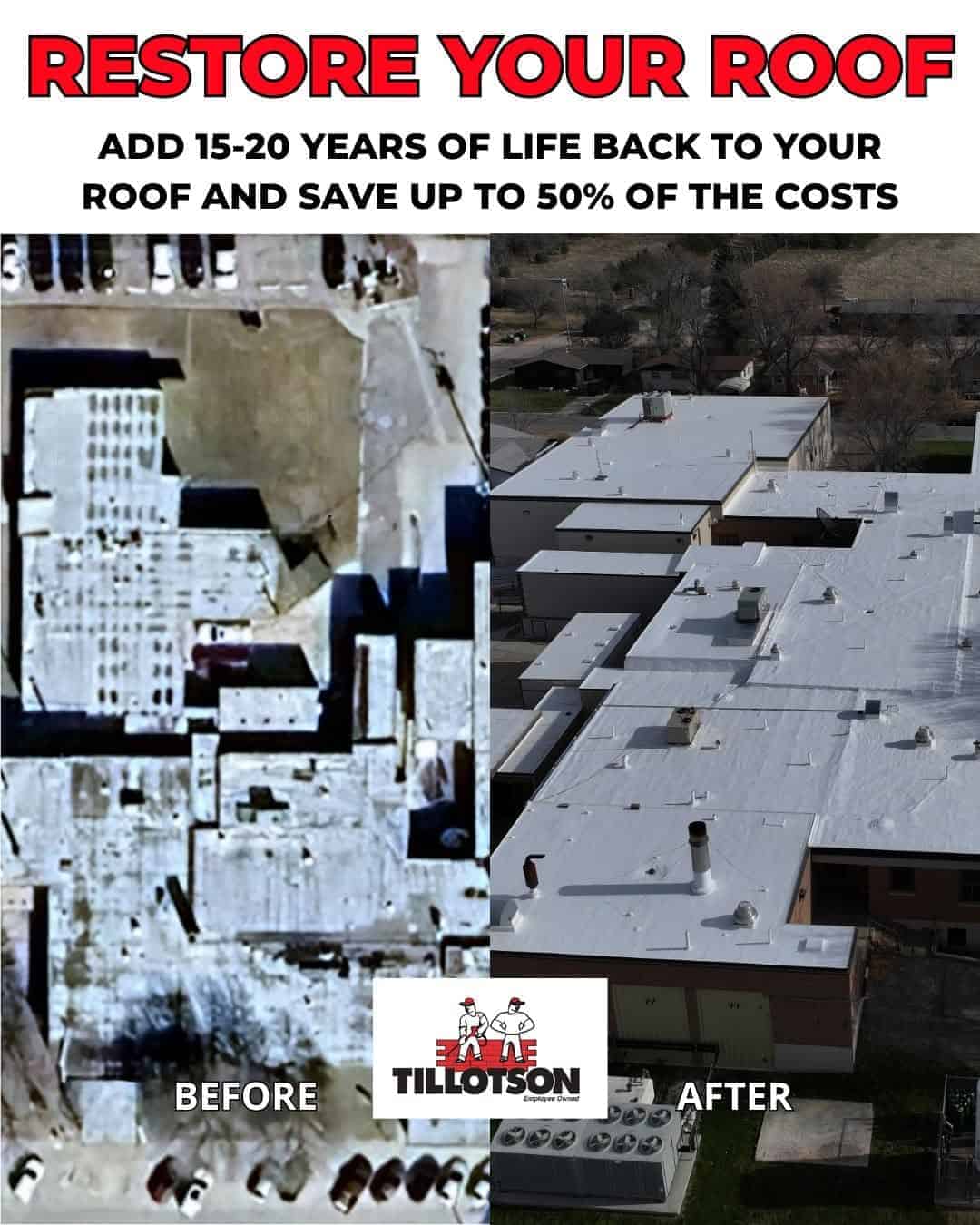
For what it's worth, our experience with mechanically fastened single-ply systems generally, TPO, EPDM, and PVC alike, lines up with a common industry pattern: screws and fasteners can back out over time, creating a direct path for water, and wind uplift at fastener points isn't rare on any of them. It's part of why Tillotson's own single-ply system takes a different approach: a fabric-reinforced ply combined with an elastomeric, liquid-applied roof coating to form a seamless membrane, rather than relying on field-welded or glued seams and mechanical fasteners at all. It's not the right fit for every roof, but it's worth knowing this option exists before assuming a sheet membrane is the only way to go.
Cost and Lifespan
EPDM tends to have the lower material cost of the two, particularly in a ballasted assembly, and a properly installed, well-maintained EPDM roof can last up to 40 years. TPO is inexpensive to manufacture and install, but because it's a newer material with less manufacturing history than EPDM, quality can vary more between manufacturers, and typical lifespans run in the 20 to 30 year range. Neither number is a guarantee. Installation quality and ongoing maintenance affect both systems more than the spec sheet does.
FAQ: TPO vs EPDM Roofing
What's the main difference between TPO and EPDM roofing? TPO is a thermoplastic with heat-welded seams and a typically white, reflective surface. EPDM is a thermoset rubber membrane with glued or taped seams, traditionally black, with a much longer industry track record.
Which lasts longer, TPO or EPDM? EPDM has the longer proven lifespan, up to 40 years with proper installation and maintenance, compared to roughly 20 to 30 years for most TPO systems. Actual performance depends heavily on installation quality and upkeep for both.
Can a TPO or EPDM roof be coated or restored instead of replaced? Both membrane types can be substrates for a roof coating restoration system in many cases, provided the underlying membrane hasn't taken on excessive moisture. A roof inspection can confirm whether restoration is a realistic option before a full replacement is considered.
Is EPDM or TPO better for a flat commercial roof? Both are designed for flat and low-slope roofs. The better fit depends on the building's climate exposure, the quality of installation available, and how the roof will be maintained over time, more than a blanket rule favoring one material.
Get a Straight Answer for Your Roof
Comparison articles can only go so far. What your roof actually needs depends on its age, its exposure, and what's underneath the membrane right now. If you're weighing single-ply roofing options or want a deeper look at TPO specifically, an on-site inspection settles the question a lot faster than another article can. Installation and material standards referenced here follow guidelines from SPRI, the industry association for single-ply roofing systems.
Schedule a free roof inspection from your nearest of Tillotson's four Nebraska offices, in Lincoln, Omaha, Kearney, or Aurora, and get a straight answer on which system actually fits your building and this state's weather.