Budgeting for a commercial roof replacement should never feel like a financial ambush. Yet for many building owners and asset managers, roofing costs appear suddenly, escalate quickly, and disrupt carefully planned capital budgets.
Why does this happen?
In most cases, it is not because roofing is unpredictable. It is because inspections were not performed regularly, maintenance was deferred, small issues were ignored, and no long-term capital plan was created.
When inspection, maintenance, and documented data are prioritized, commercial roofing becomes a predictable asset rather than an emergency expense.
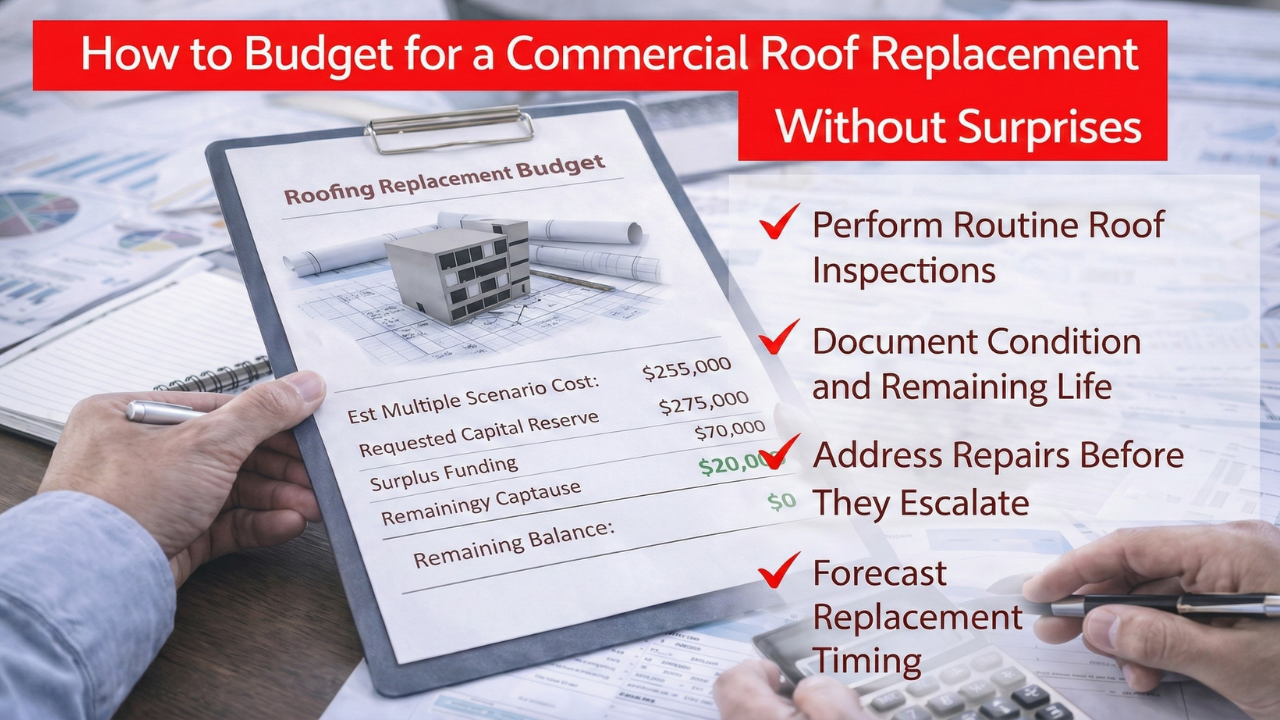
This article explains how to budget for a commercial roof replacement without surprises by focusing on inspections, maintenance programs, service departments, and long-term capital forecasting.
Why Do Commercial Roof Replacements Become Financial Surprises?
Commercial roof replacements rarely become surprises overnight.
They become surprises gradually.
What Happens When Roofs Are Not Inspected Regularly?
When inspections are not performed:
- Small membrane deficiencies go unnoticed
- Coating wear is not documented
- Moisture intrusion progresses undetected
- Minor repairs compound into major system failures
Without documentation of the roof’s condition and remaining useful life, budgeting becomes guesswork.
Guesswork leads to reactive spending.
Reactive spending leads to surprise costs.
Routine inspections are recommended by the National Roofing Contractors Association as a core component of roof maintenance planning [1].
Why Are Inspections the First Step in Budgeting?
Professional roof inspections are foundational to predictable budgeting.
The National Roofing Contractors Association recommends commercial roofs be inspected at least twice per year and after major weather events [1].
If a roof is not inspected, its condition cannot be accurately forecasted.
What Should a Professional Roof Inspection Include?
An inspection should provide:
- Identification of the roof membrane type
- Approximate age of the system
- Overall condition assessment
- Identification of deficiencies that could lead to leaks
- Recommended repairs with pricing
- Estimated remaining useful life
Structured inspection reporting supports long-term capital planning [1].
How Can a Roof Be Graded for Budgeting Purposes?
A grading system improves clarity in forecasting:
- A: Ten or more years of life remaining
- B: Five to ten years remaining
- C: Two to five years remaining
- D: Budget planning should begin immediately
- F: Replacement is necessary now
Inspection-based grading is consistent with structured maintenance reporting practices outlined in commercial service department models [3].
Why Should Inspections Be Part of a Maintenance Agreement?
A commercial roofing Service Department should offer annual Maintenance Agreements that include annual inspections [3].
These inspections are structured evaluations that:
- Summarize roof type
- Identify approximate age
- Evaluate overall condition
- Document deficiencies
- Provide pricing for recommended repairs
- Offer projected budgets for replacement or recoat when appropriate [3]
Maintenance Agreements allow building owners to:
- Track roof condition year over year
- Approve repairs before failures occur
- Budget for upcoming capital events
- Avoid emergency expenditures
Inspection documentation becomes the foundation of financial forecasting [3].
What Role Does a Dedicated Service Department Play in Budget Stability?
Commercial contracting is often transactional. Buildings are bought and sold, facilities managers change, and projects frequently go out to bid [3].
A dedicated Service Department transitions the relationship from transactional to ongoing service-based engagement [3].
What Are the Three Primary Roles of a Commercial Roofing Service Department?
A Service Department typically serves three primary roles:
1. Repairing roof leaks
2. Sealing roof penetrations for new rooftop equipment
3. Performing roof inspections [3]
Each role directly impacts financial predictability.
How Do Leak Repairs Support Budget Planning?
Repairing roof leaks is a primary function of the Service Department [3].
It is common for owners to maintain older roofs for several years while budgeting for replacement [3].
If a contractor successfully controls leaks during this period, it increases the likelihood of being selected for the eventual replacement [3].
From a budgeting standpoint, leak control extends planning time and prevents emergency capital allocation.
How Do Rooftop Equipment Penetrations Affect Roof Budgets?
Sealing penetrations for new rooftop equipment is a common service function [3].
Tenant improvements often require:
- New exhaust fans
- HVAC replacements
- Additional rooftop units
Penetrations must be sealed by authorized contractors to preserve the roof warranty [3].
Improper sealing can accelerate deterioration and increase unplanned repair costs.
Documented penetration work supports warranty compliance and long-term cost control [3].
Why Are Roof Inspections the Most Important Service Function?
Among the three primary service roles, inspections are the most important [3].
Why?
Because inspections generate data.
Inspection reports should:
- Identify deficiencies
- Provide repair pricing
- Estimate remaining lifespan
- Offer projected budgets for future replacement or recoat [3]
For roofs nearing replacement age, budget projections should be provided in advance [3].
This proactive planning reduces the risk of sudden capital demands.
How Does Data Improve Capital Planning?
Service Departments that utilize roofing software can prepare budget matrices across entire property portfolios [3].
This matrix may include:
- Inspection schedules
- Repair forecasts
- Replacement timelines
- Capital expenditure projections
Portfolio-level visibility supports asset managers in developing long-term capital plans [3].
When roofing data is integrated into planning discussions, roof projects are less likely to become emergency expenditures [3].
How Should Owners Structure Annual Roofing Budgets?
A predictable commercial roofing budget should include:
1. Annual inspections
2. Minor repairs
3. Recoats or restoration work
4. Full replacement when necessary
These categories should be informed by documented inspection findings [1][3].
How Do Spray Foam Roofing Systems Affect Budget Planning?
Spray polyurethane foam roofing systems are designed to be renewable when properly maintained [2].
Rather than full tear-off replacement, many SPF systems can be recoated to extend service life [2].
However, renewability depends on regular inspection and maintenance.
If coatings deteriorate and moisture intrusion occurs, wet foam removal increases future recoat or replacement costs [2].
Inspection and maintenance are therefore essential to preserving lifecycle value [2].
What Hidden Costs Create Roofing Budget Surprises?
Unexpected roofing costs may result from:
- Undetected wet insulation
- Structural deck deterioration
- Code compliance upgrades
- Excessive rooftop penetrations
- Hail impact damage
- Labor cost increases
- Material price fluctuations
Routine inspections help reduce late discovery of these conditions [1].
How Should Owners Build a Five-Year Roofing Forecast?
A five-year roofing forecast should:
1. Compile inspection reports
2. Assign condition grades
3. Rank buildings by urgency
4. Schedule projects across fiscal years
5. Update annually
This structured approach aligns with service-based portfolio management practices [3].
Spreading capital expenditures reduces financial disruption.
What Is the Real Secret to Avoiding Roofing Budget Surprises?
The real secret is not price per square foot.
It is not bid shopping.
It is not waiting for leaks.
It is a structured system built on:
- Inspection
- Maintenance
- Documentation
- Data
- Long-term forecasting
A commercial roof should not be an emergency purchase.
With structured inspection programs and proactive maintenance strategies, it becomes a predictable capital asset.
References
[1] National Roofing Contractors Association (NRCA). Commercial Roof Maintenance Guidelines.
https://www.nrca.net
[2] Spray Polyurethane Foam Alliance (SPFA). Spray Foam Roofing Resources and Technical Guidance.
https://www.sprayfoam.org
[3] Nolan, Luke. Running a High-Performance Service Department for your SPF Roofing Business. Spray Foam Magazine.