Spray foam roofing gets talked about more than almost any other commercial roof system – usually by people repeating something they heard secondhand rather than what’s actually documented about it. SPF (Spray Polyurethane Foam) roofing is a roofing system applied in place to form a continuous roof surface, and because it’s built on-site rather than shipped from a factory, it picks up a lot of myths that don’t hold up under real scrutiny. Here’s what’s true, what isn’t, and where the real risk with an SPF roof actually sits.
What Spray Polyurethane Foam Roofing Actually Is
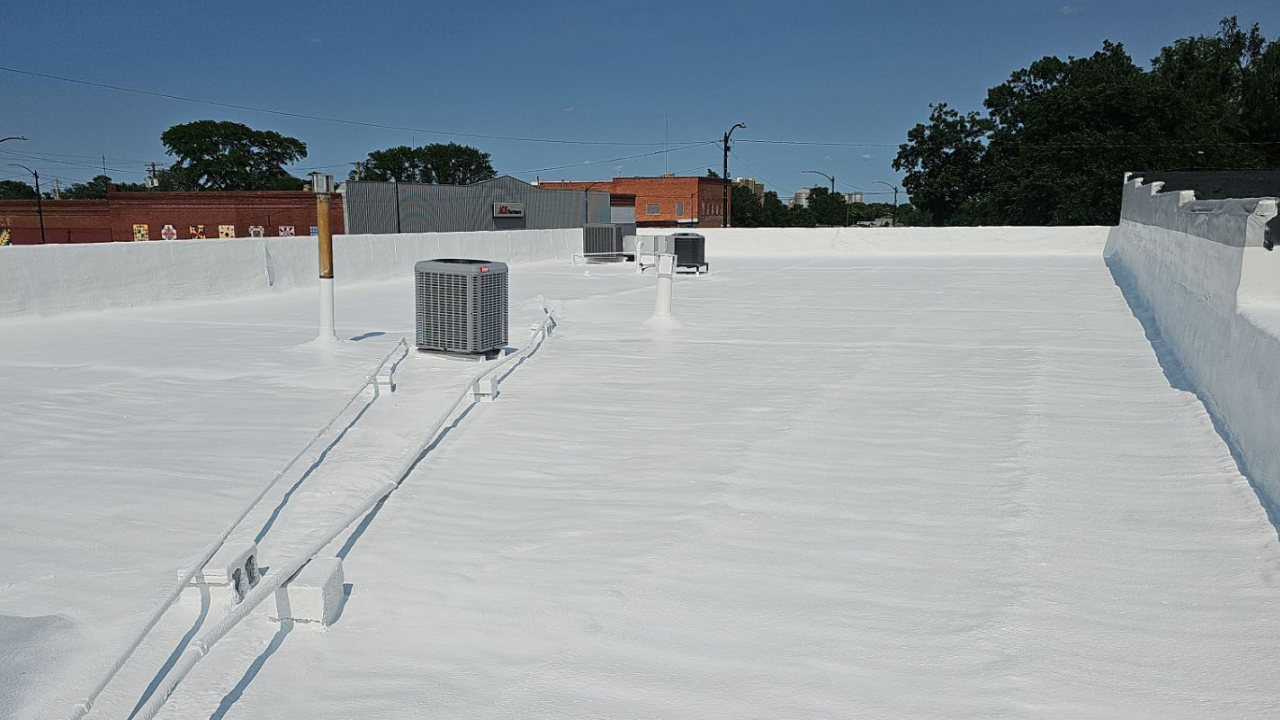
Unlike factory-made membranes, an spray foam roof system is created during installation at the building site. Foam is sprayed in place, where it expands and forms a continuous surface with no seams or joints. It’s then finished with a protective coating, which is critical to long-term durability because it protects the foam from UV exposure and surface wear. That continuous layer is also what supports the system’s long-term maintainability, provided it’s properly coated and maintained over time – which is really the thread running through every myth below. When properly installed and protected, the result is a seamless roof surface, and SPF is recognized as a proven commercial roof system category in roofing industry guidance manuals, not a fringe product.
Myth vs. Fact: What Building Owners Get Wrong About Spray Foam Roofing
Myth: SPF Is Only a Temporary Fix
Fact: Industry guidance from the National Roofing Contractors Association (NRCA) describes SPF application as a craft, and states that roof performance depends on design, material suitability, installation practices, and maintenance. That’s the framework for a long-term commercial roof system that must be properly executed and maintained – not a stopgap measure that buys a building owner a few years before a “real” roof is needed.
Myth: A Seamless Roof Doesn’t Really Matter
Fact: It matters because of where roofs actually fail. Many roof failures and leaks begin at joints, overlaps, and transitions – the exact places a fully adhered SPF system doesn’t have. Because the foam forms one continuous barrier across the roof surface, it can also encapsulate fasteners, curbs, and edges, which helps eliminate flashing and counterflashing issues at those transition points. That same continuous-surface property is also why SPF can be applied to horizontal, vertical, and irregular surfaces, making it a fit for roofs with multiple elevations, transitions, and penetrations that give other systems trouble. A seamless roof isn’t a cosmetic detail – it removes an entire category of failure point before the roof is even finished.
Myth: Spray Foam Can’t Handle Foot Traffic
Fact: It can, when it’s properly coated and maintained – but foot-traffic durability isn’t identical across coating types, and this myth usually comes from someone judging an SPF roof by the wrong coating for its use. Urethane coatings offer excellent foot traffic durability, acrylic offers good durability under normal conditions, and silicone is more limited on that specific point (more on coating types below). Matching the coating to how the roof actually gets used – regular maintenance access versus occasional inspection only – is what determines whether foot traffic is a non-issue or a real limitation.
Myth: Adding Spray Foam Means Tearing Off Your Existing Roof First
Fact: SPF is commonly used specifically because it can often be installed directly over most existing roofs when conditions allow, saving time, labor, and landfill waste. That’s also related to weight: SPF roofing is much lighter than BUR and single-ply systems, which reduces structural load and makes it suitable for older buildings and retrofits where adding weight to an aging structure is a real concern. It provides a strong, walkable surface without adding it.
Myth: SPF Is New or Unproven
Fact: The NRCA publishes manuals and guidelines specifically for SPF roof systems, including quality control and inspection and maintenance guidance. A recognized system category with its own maintenance standards and formal guidance documents isn’t a new experiment – it’s an established part of the commercial roofing toolkit, with its own body of best practices built up over time.
Myth: Any Roofing Contractor Can Install It Successfully
Fact: This is the one myth worth taking seriously, and it’s the opposite of reassuring. The NRCA explicitly states that SPF application is not an exact science – it’s a craft involving a broad range of materials, designs, practices, techniques, climates, and changing weather conditions. Because the finished roof is manufactured on-site during installation rather than in a factory, performance depends on contractor expertise rather than just the product itself. That’s a real distinction from most other roof systems, where a lot of the quality control already happened before the crew ever showed up. We cover what to actually check before hiring an SPF crew – certifications, direct employment, references, and the questions worth asking on the sales call – in a separate guide: how to choose a spray foam roofing contractor.
Myth: The Energy-Efficiency Claims Are Just Marketing
Fact: SPF is energy-efficient for a structural reason, not a marketing one: insulation is built into the roof system during installation instead of being a separate layer added afterward. Buildings often see 20 to 30 percent reductions in HVAC expenses, and reflective white coatings reduce rooftop temperatures and lower AC costs on top of that. The energy performance isn’t a side benefit tacked onto the pitch – it’s a direct result of how the system is built.
Why Coating Choice Still Matters
Because the coating is what protects the foam from UV exposure and wear, choosing the right one is one of the most important decisions in commercial roof restoration – it affects durability, foot traffic performance, water resistance, UV resistance, and how the roof can be recoated down the road. The three main options perform differently enough that the choice is worth understanding before you commit to one:
- Acrylic: best for sloped roofs with good drainage; moderate water resistance, good UV resistance, good foot-traffic durability under normal conditions, very good recoating flexibility, and a 10- to 15-year warranty range. Not ideal where water ponds.
- Urethane: best for ponding water areas and impact zones; high water resistance, excellent foot-traffic durability, good recoating flexibility, and a 10- to 15-year warranty range.
- Silicone: best for harsh conditions and ponding water; excellent UV and water resistance, but limited recoating flexibility – generally, silicone gets recoated with silicone. Warranty range runs 10 to 20 years, the longest of the three.
Since SPF roofs are maintained over time through coating renewal rather than full replacement, the coating you choose now affects your options later, including how flexible your next recoat decision will be. For what that renewal cycle actually costs over the life of the roof, see our SPF cost breakdown for the Midwest.
The Myth That’s Really a Warning: Installation Quality
Strip away the marketing noise and there’s really one legitimate concern buried in all of these myths: SPF performance depends on installation practices and maintenance, which are controlled at the jobsite, not in a factory. That makes contractor selection especially important – more important than it is for a factory-made membrane system where a lot of the quality control already happened before the crew ever showed up. Every myth on this page traces back to the same root cause when it turns out to be true on some building somewhere: not the material, but how – and by whom – it was installed. If you’re evaluating contractors for a spray foam roof, that vetting process, not the material itself, is where to spend your diligence.
Key Takeaways for Building Owners
- SPF roofing is a recognized commercial roof category with its own quality control and maintenance frameworks published by the NRCA – not a temporary or unproven fix.
- Performance depends on design, material suitability, installation practices, and maintenance – the material itself isn’t the variable that fails.
- Coating selection significantly affects foot-traffic durability, water resistance, and how flexibly the roof can be restored later.
- SPF is designed around maintainability – long-term protection comes through coating renewal on a 10- to 20-year cycle depending on coating type, not full replacement.
- Because SPF is manufactured on-site during application rather than in a factory, contractor expertise is the real variable worth checking before you hire.
With proper installation, the right coating, and ongoing inspections, spray foam roofing holds up as a long-term roof system rather than a short-term fix.
Frequently Asked Questions
What does SPF stand for in commercial roofing?
SPF stands for Spray Polyurethane Foam, a roofing system applied in place to form a continuous roof surface [4][6].
Is spray foam roofing considered a proven commercial roof system?
Yes. SPF roofing is recognized in industry manuals and quality control guidance, supporting its status as an established commercial roofing system category [4][5][6].
Does coating selection really affect spray foam roof performance?
Yes. Coating type affects water resistance, UV resistance, durability, foot traffic performance, cost, and recoating flexibility [9].
Why does contractor certification matter so much for SPF roofing?
SPF is created on-site during application. NRCA describes SPF installation as a craft influenced by many jobsite variables [6], and SPFA certification validates knowledge, skills, and abilities through a formal program [2][3].
Can SPF roofing reduce the need for roof tear-off?
Tillotson states SPF roofing can be installed directly over most existing roofs, helping reduce tear-off and landfill waste in many cases [8].
References (Sources)
ASTM – ASTM D7425/D7425M Standard Specification for Spray Polyurethane Foam Used for Roofing Applications → https://www.astm.org/d7425_d7425m-13r19.html
Spray Polyurethane Foam Alliance – Professional Certification Program (PCP) Overview → https://www.sprayfoam.org/pcp/
Spray Polyurethane Foam Alliance – Contractor Certification Infographic (ISO-17024 compliant PCP statement) → https://www.spraypolyurethane.org/wp-content/uploads/2017/08/SPF-Contractor-Certification-Infographic.pdf
National Roofing Contractors Association – Quality Control Guidelines for the Application of Spray Polyurethane Foam-based Roofing → https://www.generalcoatings.net/pdf/resource_general/NRCA-3617e-6919%20Spray%20Foam%20Roofing.pdf
National Roofing Contractors Association – Spray Polyurethane Foam-based Roofing Manual → https://www.nrca.net/roofingguidelines/Library/Detail?id=JoUxGsgkq-U%3D
National Roofing Contractors Association – Updates Its Guidelines for SPF Roof Systems → https://www.nrca.net/roofingguidelines/pdf?id=170145&k=2287701
National Roofing Contractors Association – Manual for Inspection and Maintenance of Spray Polyurethane Foam-based Roof Systems → https://www.nrca.net/roofingguidelines/Library/Detail?id=b0jZjzgNkUM%3D