Why Are So Many Commercial Roofs Replaced Before They Truly Need To Be?
Many building owners are told that once a roof begins leaking or showing age, replacement is the only option.
Sometimes that is true.
But many times, it is not.
Most commercial roofing systems do not fail all at once. They fail gradually, usually at predictable locations, long before the entire roof system is beyond recovery [1]. Understanding where and how a roof is failing is often the difference between a roof that can be restored and one that truly must be replaced.
There is no perfect roofing system. Every roof type has strengths and weaknesses, and every roof ages. Restoration is not about ignoring problems. It is about identifying them early, correcting them properly, and extending the useful life of the roof when the structure still allows it.
This article explains five clear signs that often indicate a roof can be restored instead of replaced, provided the roof is inspected properly and the correct corrective steps are taken.
This applies to:
- Single-ply roofs such as TPO, PVC, and EPDM
- Built-up roofs (BUR) and cap sheet systems
- Metal roofing systems
What Does Roof Restoration Actually Mean?
Roof restoration is not a cosmetic fix and it is not a shortcut.
A proper roof restoration involves:
- Identifying and correcting leak sources
- Managing wet insulation correctly
- Repairing weak points and details
- Protecting the roof surface from UV exposure and continued aging
When applied at the correct time, restoration can extend roof life, reduce disruption to building operations, and lower overall costs compared to full roof replacement [2].
Sign #1: Are Leaks Occurring Mostly at Penetrations and Wall Joints?
Why Do Roofs Usually Leak at Details First?
One of the strongest indicators that a roof may be restorable is when leaks occur primarily at:
- Penetrations
- Wall-to-roof connections
- Parapet walls
- Flashings
- Transitions
Roof details experience more movement, stress, and weather exposure than the open field of the roof. Because of this, they are almost always the first areas to fail [3].
When leaks are concentrated at details rather than spread across the entire roof surface, restoration is often still a realistic option.
Why Do Single-Ply Roofs Commonly Show Problems After Year 10?
Most commercial roofs installed today are single-ply systems such as TPO, PVC, or EPDM.
Over time, UV exposure and thermal cycling can cause these membranes to:
- Lose flexibility
- Shrink
- Become brittle
- Place stress on seams and flashing details
These effects tend to show up first at penetrations and wall joints, especially as the roof reaches the middle or later part of its service life [4].
This does not automatically mean the roof system has failed. It often means the roof is aging in predictable locations.
How Do BUR and Cap Sheet Roofs Compare?
Built-up roofs and cap sheet systems were once considered among the most durable roofing systems available. Many historically lasted 40 to 50 years when installed correctly.
However, roofing materials are not the same today as they were decades ago. Changes in cold-applied and coal tar chemistry, as well as changes in oil-based components, have reduced flexibility compared to older formulations [5].
As flexibility decreases, BUR and cap sheet systems commonly fail first at:
- Penetrations
- Wall joints
- Flashings
Again, failure usually begins at details rather than across the entire roof surface.
Sign #2: Are Wet Areas Localized Rather Than Widespread?
Does Moisture Automatically Mean Roof Replacement?
No. Moisture is serious, but moisture alone does not automatically require replacement.
The key question is whether moisture is localized or widespread.
Localized wet areas can result from:
- Small punctures
- Seam failures
- Ponding water
- Impact damage
- Improper previous repairs
When moisture is limited to specific areas, restoration may still be viable if those areas are handled correctly [6].
How Are Localized Wet Areas Properly Addressed?
A coating system cannot fix trapped moisture. Wet areas must be addressed as part of the restoration process.
Can Wet Areas Be Removed and Replaced?
Yes. One accepted method is to:
- Remove wet insulation and substrate
- Replace with compatible materials
- Properly tie repairs into the existing roof
This permanently eliminates moisture in those areas.
Can a Re-Dry or One-Way Vent System Be Used?
Yes, but the installation order matters.
A re-dry or one-way vent system is installed after the coating system, not before.
Why Must the Coating System Be Installed First?
If the pathways where water is entering the roof are not sealed first, a vent system will constantly be fighting new water entering the roof system.
The coating system is installed first to:
- Stop additional water intrusion
- Seal weak points and transitions
- Prevent new moisture from entering the roof system
Why Is the Vent System Installed Last?
Once the roof surface is sealed and no more water is entering the system, the vent system is installed last to:
- Allow trapped moisture to escape over time
- Help dry out the roof system after intrusion has been stopped
What Is the Rule of Thumb for Moisture?
A commonly used guideline in restoration evaluations is that if less than 30 percent of the roof is wet, restoration is often still realistic, depending on roof type, deck, and duration of moisture exposure [6].
Sign #3: Is Your Single-Ply Roof Showing Wear Without System Failure?
Why Are Regular Roof Inspections Important?
Roofs should be inspected at least once per year and twice per year as they age.
Roof failure is almost always gradual rather than sudden, which is why inspections play such a critical role in identifying restoration opportunities early [1].
What Does Wear Look Like on TPO and PVC Roofs?
Is Scrim Showing Through the Membrane?
Scrim is the reinforcement fabric embedded between membrane layers.
Visible scrim indicates the top layer of the membrane has worn thin, reducing UV protection and increasing the risk of failure if left unaddressed.
Are There Areas Where Water Has Sat for Years?
Long-term ponding accelerates aging and causes uneven wear compared to the rest of the roof surface. These areas often show deterioration earlier than the surrounding roof field.
Why Is This a Restoration Opportunity?
If wear is present but the membrane remains intact, restoration can protect the surface, reinforce weak areas, and extend roof life significantly.
Sign #4: Has the Roof Been Cut or Damaged by Construction or HVAC Work?
How Often Do Trades Cause Roof Leaks?
Very often.
Many roofs leak not because the roof system is worn out, but because:
- HVAC contractors cut or punctured membranes
- Electrical or plumbing work compromised details
- Foot traffic damaged flashings or seams
This type of damage does not mean the roof system itself has failed [3].
What About EPDM Roofs?
Black EPDM roofs commonly experience:
- Fastener back-out
- Surface chalking
- UV-related aging
These issues are often repairable when addressed early.
Can EPDM Roofs Be Made White?
Yes. Restoration can convert black EPDM roofs to white reflective surfaces, which can reduce heat buildup and improve energy performance [7].
Sign #5: Has the Roof Experienced Storm Damage but Remains Structurally Sound?
Does Storm Damage Always Require Replacement?
No. Storm damage is often localized and repairable.
Replacement decisions should be based on the extent of damage, not simply the fact that a storm occurred [1].
How Does Hail Affect Roofing Systems?
Hail can bruise membranes and damage surface coatings without causing immediate leaks. These impacts can accelerate aging if not addressed [2].
How Does Wind Damage Roofs?
Wind damage often affects seams, flashings, terminations, and edge metal. These areas can frequently be repaired as part of a restoration plan.
How Do Metal Roofs Fail and Can They Be Restored?
Where Do Metal Roofs Typically Fail First?
Metal roofs usually fail first at:
- Penetrations
- Fasteners
- Seams and mastics
Thermal expansion and contraction place constant stress on these areas, leading to sealant failure and water intrusion [8].
How Do Fasteners Cause Leaks on Metal Roofs?
Fasteners can:
- Back out over time
- Lose washer compression
- Be over-tightened or under-tightened
Improperly adjusted or poorly maintained pneumatic fastening tools can cause immediate leaks if fasteners are installed incorrectly [8].
Do Mastics and Seams Break Down Over Time?
Yes. Mastics used at vertical and horizontal seams can dry out, shrink, and become brittle, allowing water to enter the roof system even when metal panels remain structurally sound [9].
How Are Metal Roofs Restored Properly?
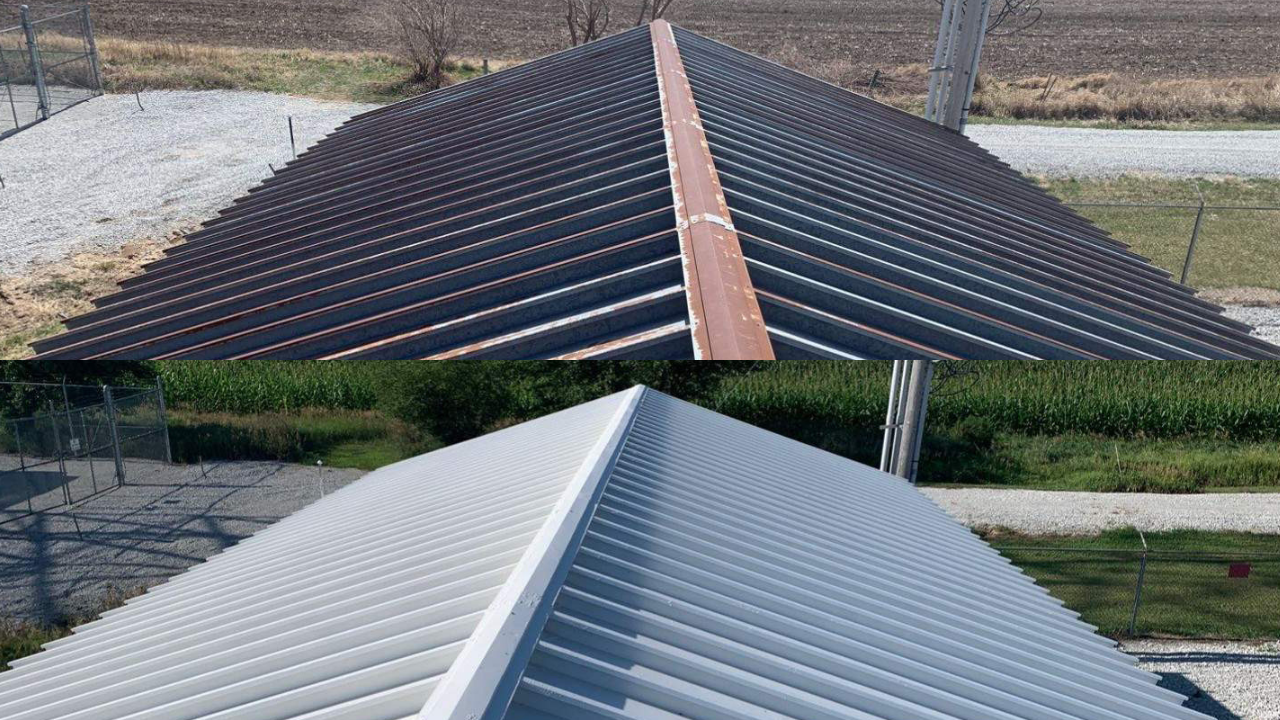
A proper metal roof restoration:
- Addresses penetrations individually
- Corrects and seals fasteners
- Reinforces vertical and horizontal seams
- Applies a white monolithic coating over the entire roof surface
When proper materials are used, restored metal roofs can often last 10 to 20 years before needing to be recoated, and recoating can extend service life further [8].
White coatings can also reduce roof surface temperatures and energy load on the building [7].
When Is Roof Replacement Actually Necessary?
Replacement may be required when there is:
- Structural deck failure
- Widespread saturation
- Severe system-wide deterioration
- Drainage problems that cannot be corrected
In these cases, restoration is no longer appropriate.
Final Thoughts: Restoration Is About Timing and Proper Repair
Roof restoration works best when applied before widespread failure and after wet areas are addressed correctly.
When done at the right time, restoration can extend roof life, reduce costs, reduce disruption, and improve overall roof performance.
References
[1] National Roofing Contractors Association, “Roof System Failure and Inspection Concepts”
https://www.nrca.net/technical
[2] IIBEC, “Roof Coatings and Restoration Guidelines”
https://iibec.org/resources
[3] We Coat Commercial Roofing, “Roof Penetrations and Leak Causes”
https://wecoatcommercialroofing.com/topic/penetrations/the-commercial-roofers-ultimate-handbook-to-penetrations-sealed-on-a-roof-system/
[4] SBR Roofing, “Roof Restoration and Membrane Aging”
https://sbrroofing.com/blog/roof-restoration-a-comprehensive-guide/
[5] NRCA, “Built-Up Roofing Systems Overview”
https://www.nrca.net/roofing-systems/built-up-roofing
[6] IIBEC Technical Advisory TA-013, “Moisture-Damaged Roof Materials”
https://iibec.org/wp-content/uploads/TA-013-2017-moisture-damaged-roof-materials.pdf
[7] ENERGY STAR, “Cool Roofs and Reflective Roofing”
https://www.energystar.gov/products/building_products/roof_products
[8] RoofXUSA, “Metal Roof Restoration Systems”
https://roofxusa.com/metal-roof-restoration/
[9] ASTM, “Sealants and Joint Performance in Metal Roofing”
https://www.astm.org/